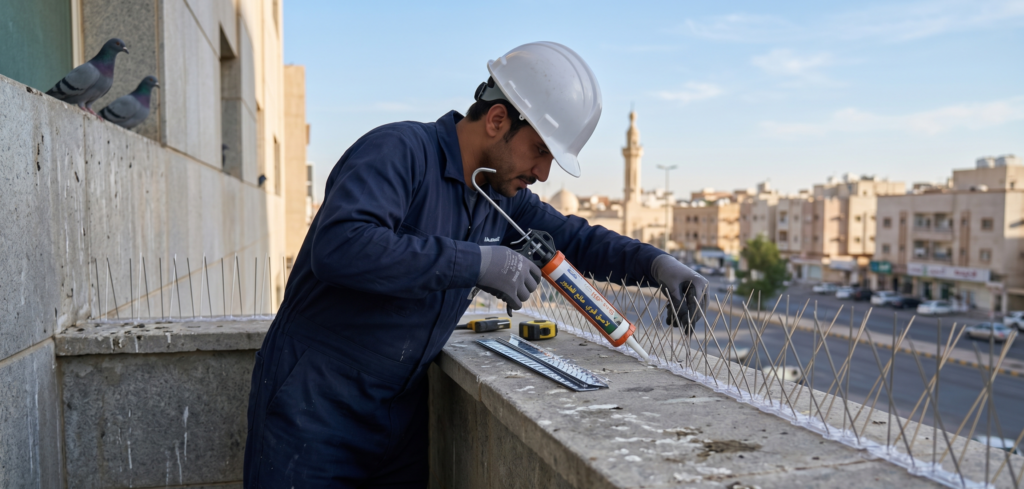
Pigeon spikes installation in Kuwait is a way to discourage birds from landing on narrow building ledges, parapets, window sills and other regularly used perches. Good results depend on covering the actual landing area with the correct barrier, rather than placing a short row of spikes wherever droppings are visible.
For a site assessment, contact 99022134 or send clear photographs through WhatsApp. Our team provides pigeon and bird deterrent services throughout Kuwait.
Where are pigeon spikes most effective?
They are suited to stable ledges and narrow horizontal surfaces where pigeons repeatedly settle. Typical locations include roof-edge parapets, window ledges, balcony rails and some architectural projections. A technician needs to inspect the width and material of each surface. Wide roof sections, open light wells and sheltered voids often require a different approach.
Why choose 304 stainless steel spikes?
304 stainless steel is commonly used for its corrosion resistance, while UV-treated mounting bases help with outdoor exposure. However, resistance depends on the wider installation: compatible fasteners, surface preparation, drainage and maintenance all matter in Kuwait’s sun, dust and coastal conditions. Material names alone do not guarantee a particular lifespan.
How should spikes be installed safely?
The installer first identifies landing areas and checks that the proposed fixing will not damage waterproofing or create problems around equipment, service hatches or moving parts. Surfaces may need appropriate cleaning and drying before attachment. The number and arrangement of rows should match the ledge’s width, avoiding nearby unprotected spots where birds could simply move.
Never drill into a water tank or waterproof membrane without a properly approved fixing method. Around air-conditioning equipment, maintain the manufacturer’s ventilation and technician-access clearances. The barrier should also avoid sharp hazards along normal pedestrian routes.
When should you use bird netting instead?
Spikes are a landing deterrent; they do not close a large opening. For spaces below roofs, building shafts and open balconies where birds fly inside, custom-fitted bird netting may be more appropriate. Before closing a void, check for occupied nests or trapped birds and plan a humane solution.
What affects the installation price in Kuwait?
Cost depends on the total length and width of ledges, building access, the selected spike system, cleaning needs and complexity of fixing. For an accurate scope, share the location, approximate dimensions, and photographs of the areas where pigeons land. An initial discussion is possible by phone, but it should not be mistaken for a final quotation.
How can you maintain pigeon spikes?
Inspect the installation periodically for loose sections, dirt buildup and newly used landing points. Maintenance can be particularly important on exposed roofs and coastal properties. If pigeons begin gathering nearby, identify the new landing spots before extending the coverage.
Frequently asked questions
Do pigeon spikes hurt birds?
Properly selected and installed systems are intended to prevent landing, not injure birds. Positioning and inspection are important, and no system should trap birds in an enclosed space.
Are spikes enough to protect an entire roof?
Not necessarily. They protect specific landing edges. Wide surfaces, openings or nesting voids may require a combination of spike and netting solutions.
Can spikes be installed on outdoor AC units?
Sometimes on suitable nearby landing points, provided service access and airflow remain unobstructed. Do not attach barriers to moving or sensitive equipment components.
What about coastal buildings?
Choose suitable corrosion-resistant materials and fasteners and check installations regularly. The site conditions determine the fixing method.
Book a property assessment in Kuwait
We assess pigeon landing and entry points for villas, residential buildings and commercial properties across Kuwait. See all bird control services, read more advice, or contact us at 99022134. You can also send photographs on WhatsApp to discuss a suitable approach.